Are you a reader with an iPhone or an iPod touch? equivocality.com is now optimized for mobile web browsing. I also created a special icon (it’s kind of hard to make out the grid background in the picture, but it’s there) that will replace the screenshot that Safari takes when saving a site as a web clip. Updates are only one click away!
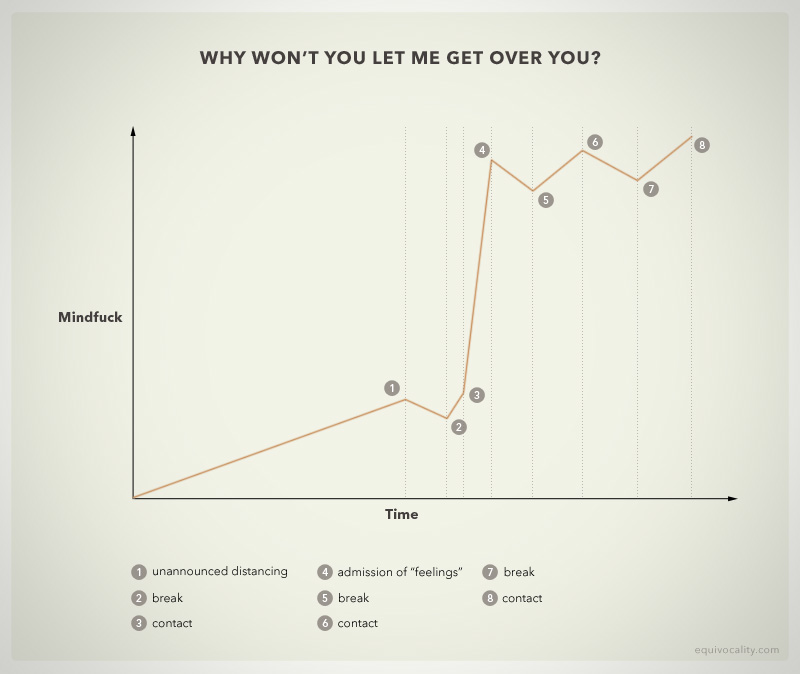
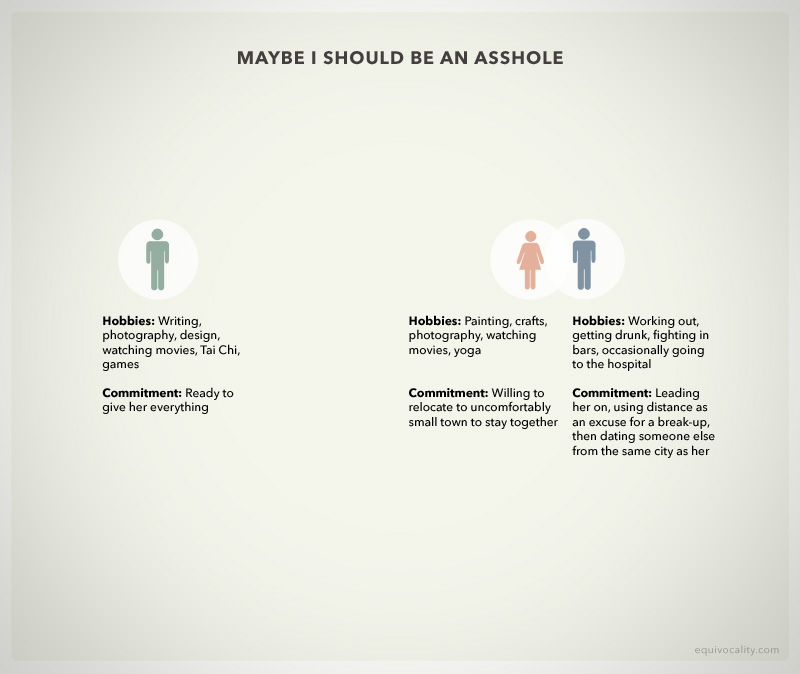
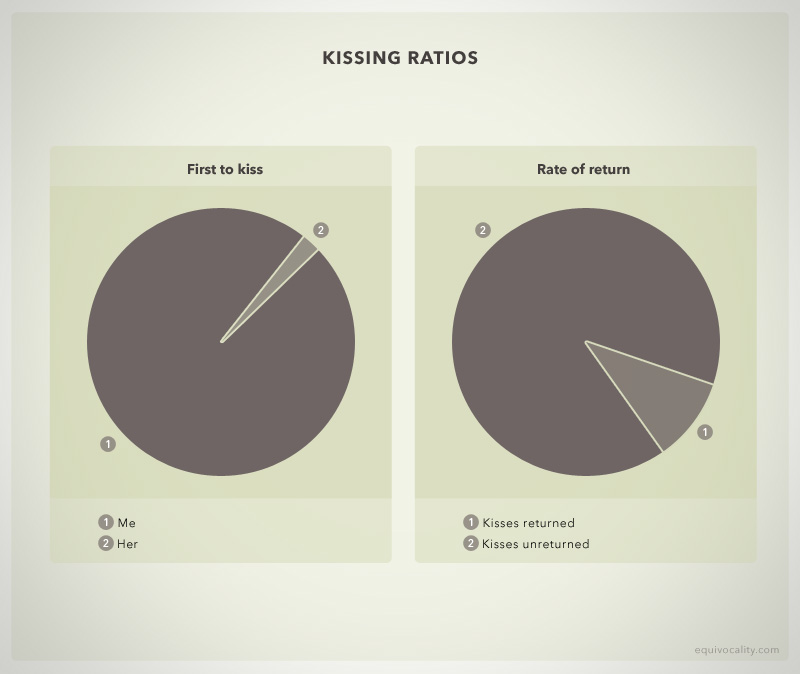
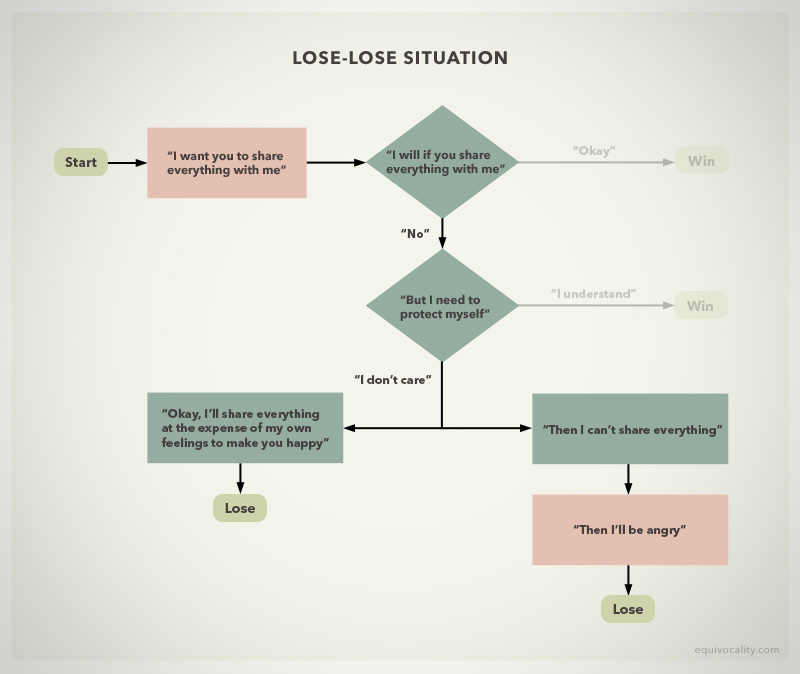
I love making these little diagrams. It’s so cathartic. I remember reading this xkcd comic (Do you know the functions? Answers in the footnote1.) a long time ago, and thinking, “Yeah, I don’t get it either”.
I’ve always been a visual person, but I never realized that doing something like this would make things so much clearer. All those years earning a degree in computer science — learning Venn diagrams, flow charts, and the like — have finally come in handy.
From left to right, top to bottom: square root of love, cosine of love (trigonometry), derivative of love (calculus), matrix multiplication of love (linear algebra), and someone help me out with the last one, it seems like another calculus equation with some constants thrown in the Fourier transformation of love (Hat tip to Edd Sowden for this one). [↩]
I suppose I’d have more to say if it wasn’t for the fact that I’ve pretty much said everything already. I’ve dealt with the uncertainty, the unanswered questions. I’ve suffered enough.
Sometimes I question whether or not I really know what suffering is. Reading back on my last entry, it struck me that in many ways, my life wasn’t that bad.
A Hero Of Our Time was written during great military conflict, where people were frequently “exiled” by being sent to remote places along the front of the Russian-Circassian War, where Russia had already been fighting for over 40 years. Some may argue that I don’t truly understand suffering, because my culture hasn’t been through something like this, whereas such pain is already in the blood of Russians. Even in popular culture, such as Babylon 5, the Russian character Susan Ivanova (whom I quoted in this tweet) seems to follow this stereotype.
So can I truly relate to this without having gone through any of it myself?
If you look at Aya Nagatomi’s performances of Chopin, specifically her interpretation of his Étude Op. 10, No. 12, you can tell that it’s technically amazing — certainly a virtuoso in the making as she’s only 19 in this video — but you don’t feel the rubato with which Chopin intended it. As such, it sounds like it’s being performed by a computer. You have to wonder whether it takes a certain degree of hardship experienced to do it justice, perhaps going through the political turmoil of the November Uprising in Warsaw that inspired Chopin to write this Revolutionary Étude.
Could Leonard Cohen have been able to pen a song like Famous Blue Raincoat without having suffered through a few lonely nights in New York City? I think not.
I don’t know enough about Chinese history to know what my ancestors went through. The relatives I know of in previous generations escaped the Cultural Revolution — where they would have been subjected to unbelievable hardships — to Hong Kong. Maybe it’s not in my blood, and I’m just drawn to the idea of Nihilism on a superficial level, never truly understanding it any deeper.
But a long time ago, I remember reading an entry by Tina where she felt disturbed by other people’s opinions on how jaded she was feeling, as they were saying she had nothing to feel bad about. I told her not to compare herself to others. That one person going through heartbreak is a different kind of suffering than a person going without food, and that one can’t said to be more “painful” than the other.
I may have been well-fed, healthy, and from a middle-class family in my childhood. But none of things mattered to me because it was the emotional connection that I was seeking, but could never find.
I’ve always had the bad habit of comparing myself to others. I should probably just follow my own advice and enjoy the comfort, beauty, and inspiration that Russian literature gives me.
After all, if I can acknowledge that my suffering is my own, no one else would truly understand anyway!
The story of a human soul, even the pettiest of souls, can hardly be less interesting and instructive than the story of a nation…
Many of my earlier entries contain references to Russian Romantic literature, but I’ve never explained my fascination with it. I’ve always identified with ideas of the Byronic hero and Nihilism, whether they were ideals or philosophies I felt drawn to. It was one book that introduced me to these ideas, called A Hero Of Our Time by Mikhail Lermontov, a Russian poet (in the truest sense of the word) who died in a duel at 26. Whenever I meet someone from Russia, I ask them if they’ve read it, in the hopes that perhaps I can gain some insight into this book from someone who understands the original language. I read it when I was in grade 9, and so much of what the protagonist, Pechorin, made sense to me.
Death
Ah, well! If I must die, I must! The world will lose little, and I am weary enough of it all. I am like a man who yawns at a ball and doesn’t go home to sleep only because his carriage hasn’t come.
During a brief phase, I’d say about year off and on in high school, I was at the very depths of depression and somewhat suicidal, but I could never bring myself to do it. I was just hoping death would take me. It was an easy way out. Not only did I have no reason to live, but my life was quite unpleasant. My best friend had ditched me for the popular crowd1, so my time at school was miserable, then I’d come home to an empty life and parents that ignored me.
Ever since, I’ve felt like I’ve been living on borrowed time, waiting for the end to come, when it should have already arrived. That’s why I remain unphazed by the idea that I’m going to die, and accepting of the fact that it’ll happen one day. As Pechorin says near the end of the novel, “After all, nothing worse than death can happen — and death you can’t escape!”
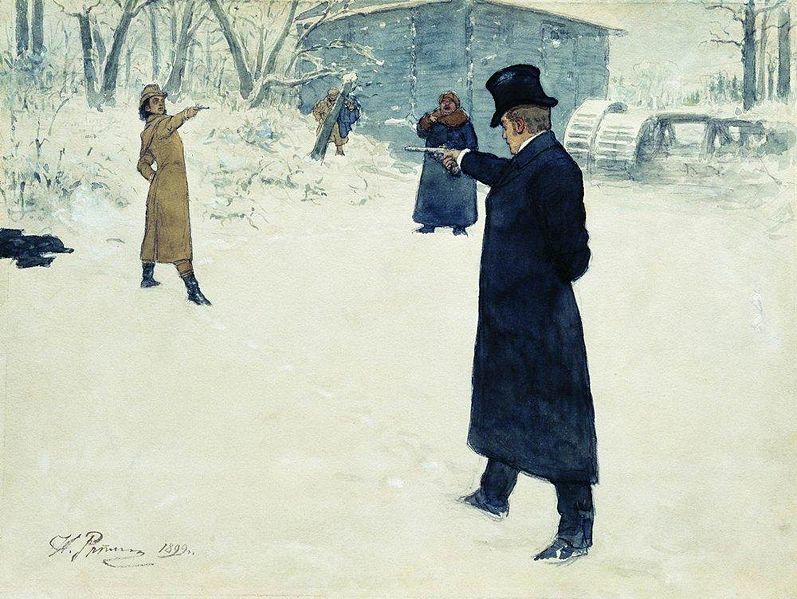
There’s a particular scene in the movie Onegin2 that captures the spirit of this morbid acceptance. Onegin (played by Ralph Fiennes) has been challenged to a duel that he cannot back out of, lest he be the subject of ridicule, so he accepts. He’s fired upon as he’s walking towards his opponent, and, faced with death, simply closes his eyes. The expression of calm in his face shows that it’s out of reflex, instead of fear.
This was made especially more painful by the fact that I was so insecure that I defined myself through others, being left without being anyone’s “best friend” meant that I was worthless. [↩]
Written by Alexander Pushkin, arguably Lermontov’s biggest influence. In fact, as the character Onegin was named after the river and lake, Onega, Pechorin was similarly named after the river Pechora. [↩]