
Featured on Slashdot on June 12th, 2006, under Toys, Space, and Science.
Introduction
Pat once told me that he harbours an inexplicable compulsion to be in space. His belief is that when he’s finally there, he’ll have all the answers. Life. God. 42. The metaphysical implications don’t make sense, yet this is what he truly thinks. It’s a strange hole in the logical being I know as Pat, and only the enigmatic curiosity of the night sky can do this to someone.
I’m no exception. Something borne in us from childhood is a fascination that stems from the unknown. The stars provide enough for us to wonder about for a lifetime.
Unfortunately, for those who live in the city, there’s little chance to see the sky without “sky glow”, the annoying phenomenon that drowns out a large number of stars visible to the naked eye and telescope alike. As a by-product of industrialization, light pollution has taken the sparkle out of the stars, and this is where the HomeStar comes in.
What Is A HomeStar?

According to the official Homestar website, (translated through Babelfish):
“It is the planetarium for worldwide first optical type home. It is possible to exceed several thousand numbers of stars that to project approximately ten thousand thing stars it can see generally with naked eye of the human.”
According to me, the Sega Toys HomeStar is a home planetarium. It turns any room into an astronomical theatre, by projecting up to 10,000 stars onto a wall or ceiling.
Alternatives to the HomeStar until now have been rather crude. About.com has a list of Top Toy Planetariums, and most of them aren’t above $40 USD, giving kids a few fuzzy points of light on a nearby wall. There’s also the StarDome, which offers a better image, at the cost of a much more significant investment. This includes a week of construction, electrical work, as well as a steeper price.
The HomeStar is mid-ranged geek toy. It’s provides an extremely detailed star field, while remaining portable and affordable ($239.00 USD as of June 2006).
Specifications:
- Weight: 1 kg
- External size: W16.7 x H15.9 x D15.1 cm
- Power source rating: Input — AC100V, 50/60Hz / Output — DC5V, 1.2A
- Electric power consumption: 3w
- Electric battery life: 6 hours
- Power source: Private AC adapter / private electric battery box
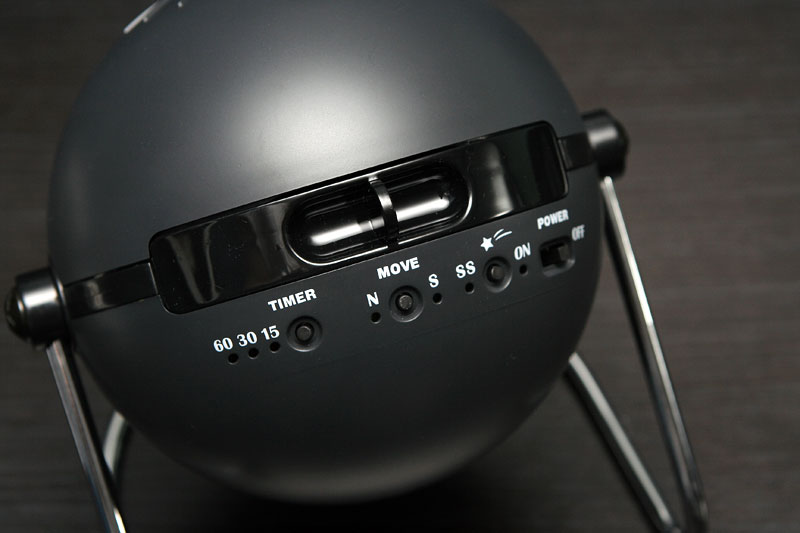
The HomeStar also comes with three features. There’s a random shooting star generator, which projects an ephemeral comet that flies through the stars. A sleep timer allows the unit to turn off automatically after a set amount of time. The projection can also rotate, to simulate the rotation of the earth.
Package Contents

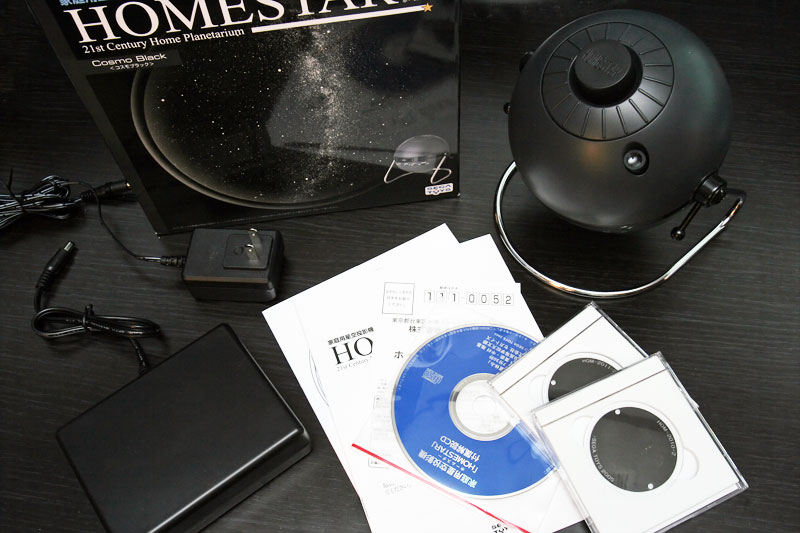
I ordered my Homestar from Audiocubes, a sort of middle-man to Japan. The order was placed on a Thursday, shipped on Sunday, and arrived on Tuesday. Not bad.
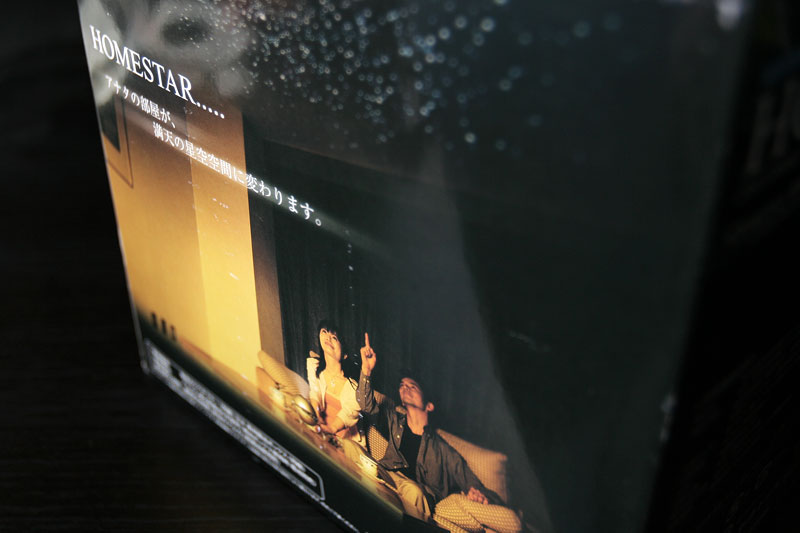
The Homestar comes in a stylish box, with pictures of the night sky on the side.
In the box
- HomeStar
- Two northern sky discs (with and without constellations)
- AC Adapter
- Explanation Handbook
- Explanation CD
- Battery Box

Unfortunately, all documentation, as well as the explanation CD, are in Japanese. As simple as it is to use the HomeStar, there are some rather intimidating images in the manual that make me feel like there’s something I should know.
One can also purchase two southern sky discs, but at an extra $80 USD, I didn’t think it was worth the price. I don’t think they can be shipped separately, so the decision should be made before ordering.
Design And Construction
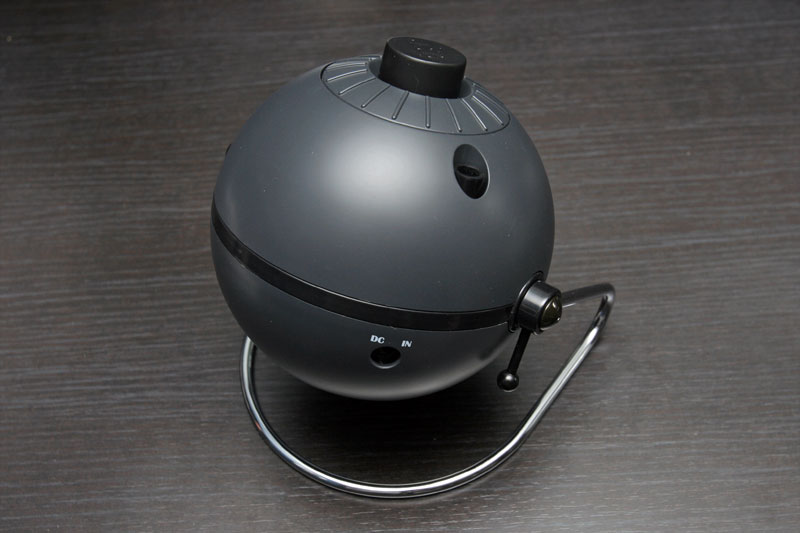
The HomeStar usually comes in two colours, silver and black, although limited editions have special gradient and pastel colours. It comes in a matte finish, while the well-designed silver base adds a nice contrast. Soothing curves give it a modern look. It’s stylish enough that it can be stored almost anywhere out in the open without looking out-of-place. I chose the black so that it wouldn’t stand out in the room, although this also means that it’s harder to see in the dark, making it potentially easier to break.
The unit is much lighter than expected, but not to the point where it feels flimsy. I imagine that inside is simply a lens used to focus the stars, a motor to rotate the discs, and a light source.
Shaking the sphere doesn’t cause any rattling.
Buttons are solid, with good tactile feedback. The focus ring is much too loose for my preference, although this may be good because it can take quite a lot of turning to get the stars to the right sharpness. I also have a difficult time remembering which direction to turn the know for closer or further focus, as there’s no visual markings on the unit itself. I bet there are Kanji characters for clockwise and counter-clockwise somewhere in the manual.

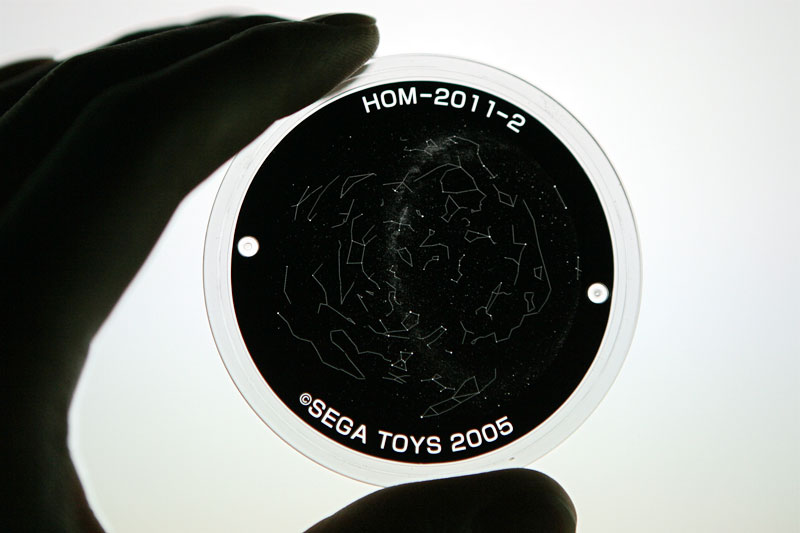
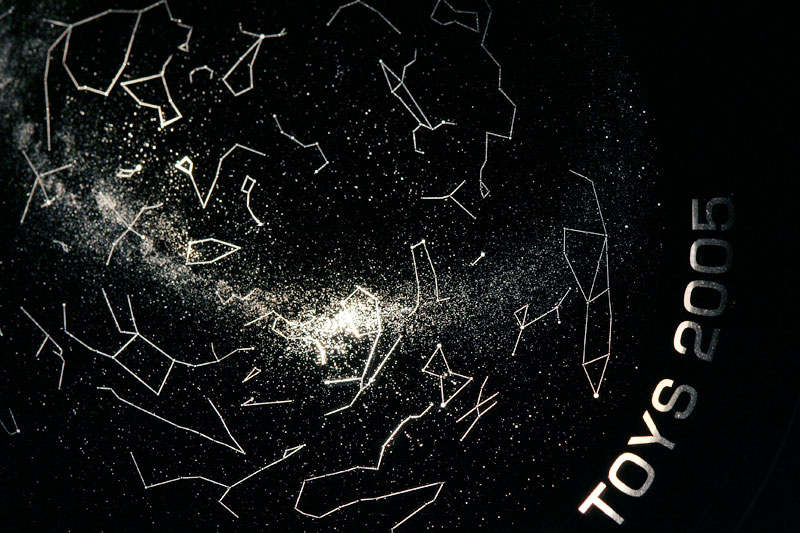
The image discs are much more solid than they look in the pictures. They’re about 3mm thick, made of sturdy plastic that doesn’t bend. The thing to be most careful of is getting the surface of the disc scratched. Although this wouldn’t actually ruin the thin black layer of stars sandwhiched between the plastic, may it may still alter the image.
Using The HomeStar


Stucco ceilings are not a problem; the starfield shows up crisp and clear on mine. The HomeStar should be placed in the middle of the room. If it’s too much to one side, the depth of field is too narrow to contain both sides of the field, resulting in a stretch. Unfortunately, this isn’t always easy or convenient. The effect can be seen in the picture on the left. However, it does come with a battery box that allows for more portability. This is supposed to last up to six hours, but the AC cable is long enough that I haven’t had to use this yet.
The projected image doesn’t include the entire sky, just a portion of the disc. This makes the rotation feature much more valuable, as it cycles through the sky once every six minutes. It’s a very subtle effect. Often, I’ll have to ask a second opinion whether the stars are actually moving. The image can be slightly dizzing; I’m reminded of the morning of a hangover, when the entire room seems to spin.
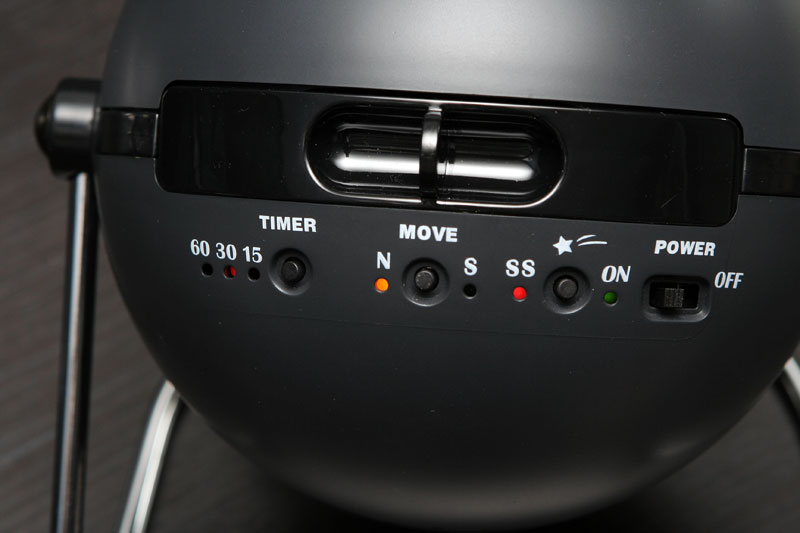
There’s very little light leakage from the HomeStar, and this is a very important feature. The mode LEDs are rather dim, and the projection lens is recessed inside the unit enough that you can’t easily blinded if you happen to walk by the unit. Any stray light will wash out the stars; light pollution exists inside the house now, with superbright LEDs on many electronic units. I find myself covering up the LEDs from my bluetooth charger and speaker panel when using it.
The shooting star generator is a little disappointing. The small comet comes at a set interval, and at the same location every time. Not quite the mystical, random effect that I was hoping for.
For those with glasses, the use of the HomeStar becomes a little more limited. After taking your glasses off to go to bed, the starry ceiling becomes somewhat of a blur, depending on the strength of your prescription. There’s still a sparkle in the eyes, but it’s not the same effect of sleeping under the stars that you pay for.
Conclusion
The HomeStar very effectively simulates a clear, starry night. With a darkened room, the effect becomes quite romantic. It can’t match the actual night sky while camping or out in cottage country, but for people who live in densely populated areas, it does the job well. Makes a great gift, especially for people who have everything, and kids with space-themed rooms. Astronomy (and eventually astrophotography) is something I hope to afford some day, but until then, the HomeStar will give me the enough of the heavens that I need. A highly recommended item, if price isn’t a problem.
where can I buy it?
whew
good lord, you got some time on your hands, to write such an extensive review.
Sounds cool though.
I’m an amateur astronomer myself, but, like you , living in a big city robs us of a full-blown starry night experience.
The type of telescope I have is good for combating the local light pollution.
It’s awesome for planet gazing…moon gazing… and the bigger stars and nebula’s
I haven’t had time or opportunity to use it since i had babies…
but one day I’ll pull it out of its’ box again, get it all tuned up and USE IT.
Even if I had the $, I don’t think I could ‘dig’ a artificial night sky..
I’d rather suffer with the light pollution and look at the real thing..what you can see of it anyways…
Besides, I loved the challenge of LOOKING for a certain star in the night sky, with the telescope, it’s a lot like fishing, when you’re a beginner..
enjoy your synthetic stars ;)
sorry, I’m always a bit ‘cheeky’
where were your reviews on digital cameras when I needed them ;P
hehehe
cheers, Amy
If you send me a copy of the pages in the manual you want to know about, I can give you a quick summary. I have a bachelor’s in Japanese and speak it in my home with my wife.
Chris,
Long ago you mentioned translating the manual for the Homestar from Japanese to English. I recently purchased and just received the Homestar Extra. It was supposed to come with an English version of the manual but it only came with the Japanese manual. Do you know where I can find an English version of the manual?
Cheers, Mark
You can actually order one of these more cheaply through amazon.co.jp :
http://www.amazon.co.jp/exec/obidos/ASIN/B0009E387O/qid=1150128632/sr=8–1/ref=sr_8_xs_ap_i1_xgl/249–8205765-1954745
It’s a little bit of a hassle if you don’t speak japanese, but the amazon website look and feel is essentially the same regardless of language. The Southern hemisphere disks can be ordered separately through amazon as well.
We use ours as a nightlight for our three year old — she sets it up on her own now.
This seems like a pretty cool toy — I especially like the idea of a sleep timer :) One of the several pleasures of camping away from all the light pollution is to be able to get lost in the vast distances and time that the stars represent. I’d be impressed if this could instill even some of the feeling that I get from the experience of camping out on a clear night…
You can purchase one here from an American site that is in English.
http://www.audiocubes.com/product_info.php?products_id=1587
the amazon.jp site lets you switch to “display in english” :)
i don’t believe the japanese amazon can ship to the US, or so the google-BETA translated site says-
“Restriction of overseas delivery: As for this commodity, Japan it cannot deliver overseas.”
Sweet, you are slashdotted.
This would make an awesome trip toy.
Wow, thanks for the comments…glad my server could handle the /. effect.
Unfortunately, my reviews on digital cameras are limited to the fact that I only have two. For that I’d recommend http://www.dpreview.com, which is what I use.
Thanks for the generous offer to translate the manual, Chris, but I think I’d rather keep the manuals a mystery, heh.
And yes, I do have too much time on my hands.
I got my English one from Toys.Brando http://toys.brando.com.hk/prod_detail.php?prod_id=00109.
Yep, that is really cool and I especially love it in my bath time.…
I purchased the cheaper version called “Homestar Pure”. I love the design and the price. At half of the price of the original one, it released in 2007. If you don’t need the shooting star and auto-rotate function, then I recommend the “PURE” version.
http://www.segatoys.co.jp/homestar/pure.html