
The story of a human soul, even the pettiest of souls, can hardly be less interesting and instructive than the story of a nation…
Many of my earlier entries contain references to Russian Romantic literature, but I’ve never explained my fascination with it. I’ve always identified with ideas of the Byronic hero and Nihilism, whether they were ideals or philosophies I felt drawn to. It was one book that introduced me to these ideas, called A Hero Of Our Time by Mikhail Lermontov, a Russian poet (in the truest sense of the word) who died in a duel at 26. Whenever I meet someone from Russia, I ask them if they’ve read it, in the hopes that perhaps I can gain some insight into this book from someone who understands the original language. I read it when I was in grade 9, and so much of what the protagonist, Pechorin, made sense to me.
Death
Ah, well! If I must die, I must! The world will lose little, and I am weary enough of it all. I am like a man who yawns at a ball and doesn’t go home to sleep only because his carriage hasn’t come.
During a brief phase, I’d say about year off and on in high school, I was at the very depths of depression and somewhat suicidal, but I could never bring myself to do it. I was just hoping death would take me. It was an easy way out. Not only did I have no reason to live, but my life was quite unpleasant. My best friend had ditched me for the popular crowd1, so my time at school was miserable, then I’d come home to an empty life and parents that ignored me.
Ever since, I’ve felt like I’ve been living on borrowed time, waiting for the end to come, when it should have already arrived. That’s why I remain unphazed by the idea that I’m going to die, and accepting of the fact that it’ll happen one day. As Pechorin says near the end of the novel, “After all, nothing worse than death can happen — and death you can’t escape!”
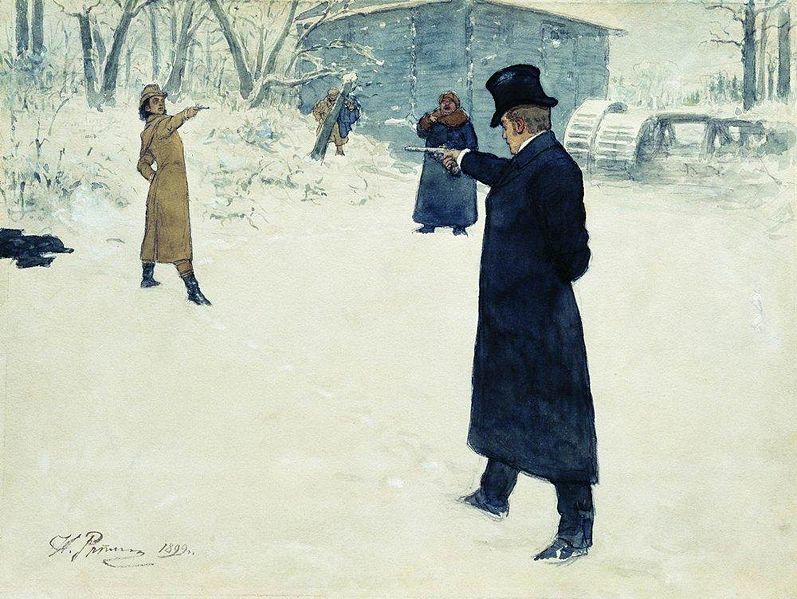
There’s a particular scene in the movie Onegin2 that captures the spirit of this morbid acceptance. Onegin (played by Ralph Fiennes) has been challenged to a duel that he cannot back out of, lest he be the subject of ridicule, so he accepts. He’s fired upon as he’s walking towards his opponent, and, faced with death, simply closes his eyes. The expression of calm in his face shows that it’s out of reflex, instead of fear.
Vapidity
They are often endowed with many good qualities, but they have not an ounce of poetry in their souls.
One of the antagonists of Pechorin is Grushnitsky, a poseur who walks with a fake limp to draw sympathy and wears a greatcoat to look important. Pechorin and I share the same mocking scorn of such “foppery”. What can I say. I hate fake people. The ones who put on affectations to seem unique or eccentric. The ones who pretend to be what they’re not. I know too many people like this, and I try to avoid them as much as possible.
Women
Mon cher, je méprise les femmes pour ne pas les aimer car autrement la vie serait un mélodrame trop ridicule.
I don’t completely agree with Pechorin’s attitudes towards women, as they can be quite sexist (he frequently compares them to thoroughbreds, for example), but I do relate to his frustrations, and very contradictory opinions on them. It’s a love/hate relationship — the typical “can’t live with, can’t live without” idiom — that’s at once bordering between the indifferent and the impassioned. Perhaps this is due to the fact that my experiences with women are so polarized. After all, the ones we love the most are also the ones that can hurt us the most.
Emotions
My whole life has been merely a succession of miserable and unsuccessful denials of feelings or reason.
Much of my childhood was spent feeling greatly disillusioned with the world. I was living with my parents, who made me believe that emotions were bad, not because they’re useless, but simply because the only emotion I experienced with them around was depression. I felt unloved and useless, so I tried to cover up these sad emotions with logic, and Pechorin seemed to share this habit. It’s all the more relatable because he’s not completely in control of them. He’s flawed and human, even though he’s part of the intelligentsia.
Even now, I find myself constantly trying to balance my emotions, because I simultaneously appreciate them for their inspiration, and despise them for their effect on me.
- This was made especially more painful by the fact that I was so insecure that I defined myself through others, being left without being anyone’s “best friend” meant that I was worthless. [↩]
- Written by Alexander Pushkin, arguably Lermontov’s biggest influence. In fact, as the character Onegin was named after the river and lake, Onega, Pechorin was similarly named after the river Pechora. [↩]
Thanks for sending me scurrying off through another history pursuit, all the way to researching pics of Byron’s boyhood home.… very jealous…oh for a title.
Funny: I read the Byronic hero description and went: Oh! Two of my boyfriends, at very least!… explains a lot…
Isn’t it great we no longer are emprisoned in our childhood views of ourselves? I recall an actual moment around 10 or 11 when I had a flash and remembered vividly how I felt just being me at age 5 or 6. A HORRible feeling, I shuddered to remember it. I remember thinking, even at 10, “What a relief not to be that scared, unhappy person anymore.”
Somehow I suspect a lot of others don’t understand that, because they had different kinds of childhood.
The internet can definitely be a time-sink for topics like this. Sometimes, it takes a little reflection to understand how far I’ve come from the image of myself in childhood. Quite a relief.