
When I watched Moonstruck in my university “Music in the Movies” class, we studied a scene where Ronny Cammareri (Nicholas Cage’s character) has a date with Loretta Castorini (played by Cher) at the Metropolitan Opera. She takes off her coat, and he says, “Thank you…You know it’s been a long time since I’ve been to the Opera”.
In his face, you see that he’s not talking just about the opera. After losing his hand and fiancée, he’s at the Met, arguably the most prestigious opera house in the world, with a beautiful woman in a black dress, and he’s missed this.
Even in the screenplay, there are set directions for the scene when they arrive:
CROWDS OF PEOPLE in beautiful clothes fill the plaza created by the three great buildings. A glorious fountain filled with lights forms the centerpiece. Behind the fountain, grand and splendidly lit, is the magical Metropolitan Opera House.
Ever since, The Met has been this place I’ve dreamed of attending. Unfortunately, it’s in New York, and decent seats can cost over $100.

So when my local movie theatre started offering live HD broadcasts of performances there, I decided I should go. To fulfill a dream in spirit, if not in the flesh.
The Story
The opera of Orfeo ed Euridice by Gluck is based on the Greek myth of Orpheus, the father of songs, who ventures to the underworld to bring his wife, Eurydice, back from the dead. He does this by playing his lyre to soften the hearts of the caretakers of Hades.
There are two conditions, however. On their journey back to the living, he’s not allowed to look at Euridice, nor tell her why. Though she’s beset by doubt and misunderstanding, they make it to the edge of the underworld, only to have Orpheus look back before Euridice is safely through as well, and he loses her forever.
It was certainly the story that drew me more anything else. Orpheus not only making the Gods weep, but seducing the shades with his dulcet music as well. Defying life and death itself with the power of art. There’s so much emotion in it. Orpheus reuniting with his wife after death, trying to dispel her insecurity, and losing her again.
There’s a variation in the opera; he sings so mournfully again, than the Gods take pity on him and bring her back to life. I’m not sure if I enjoyed this change of story. It smacks of audience pacification, going against the authenticity of the original Greek play.
The Presentation
Before the opera started, there was operatic trivia on the screen (much like the Hollywood trivia before a movie), along with live footage of the audience taking their seats and the orchestra getting warmed up. One advantage of such a venue is that there was a brief introduction and interviews with Met music director/conductor James Levine and choreographer, Mark Morris. The interviews were great for providing a bit more insight into the performance before it started.
The cameras offered a view that even people in the front row don’t get. There’s an intimacy with the singers that can be achieved when you can see their emotion, breathing, and sweating. Enough that it reminded me of being on stage from my childhood years of musical performance. You feel the nervous chatter of the musicians before they began, tinkering with their instruments, warming up their fingers, and it all adds to the experience.
I wasn’t used to a woman playing the male lead, which they call a “trouser role”. I think a certain amount of chemistry is needed, and it’s distracting with the one gender playing two because it seems a little forced. There’s also a certain male timbre that’s extremely difficult to reproduce as a woman, and distracts from the willing suspension of disbelief.
The Art
The opera was a through piece, which meant the performance went for an hour and a half with no interruptions. That made it very digestible; something I strongly appreciate, as I can only take so much opera in one sitting.
The music was quite enjoyable, though my favourite part was when Orpheus goes to the underworld for the first time, and sings for the dead. On the other hand, the dance seemed a little lacklustre, though I’ve never been one to appreciate such a medium.
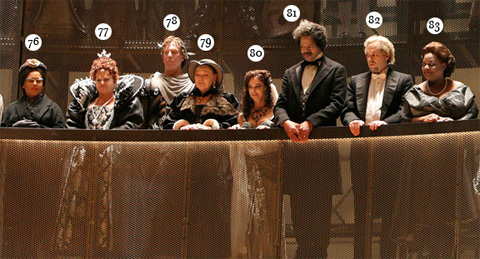
I particularly enjoyed the modern take on it, with the lute instead of lyre. Costumes too were modern. The chorus of the dead were meant to represent everyone in history, among the faces were modern people, like Abraham Licncoln, John Lennon, and Babe Ruth.
One thing the director explained was the extended dancing scenes. Composers wanted opera to be a combination of all art forms, something I previously believed was held by cinema. There’s certainly something to be said about the medium of opera in this regard, or perhaps about the limitations of artistic mediums in general. Perhaps they shouldn’t be compared, and simply appreciated for what they can achieve.
On the first opera performance I ever worked on, making crafts items such as jewelry, armour, etc. for the principals, I was so into making my objects and focusing on handling my job that I didn’t really think about the singers who were going to wear them, even though I’d studied classical singing a bit. Working there was magic.
Seeing them wearing my stuff onstage actually overshadowed my hearing them sing, until I attended a final dress rehearsal with few people in the hall, sitting as close as I could get.…. It was REALLY MAGIC.
But then secondly, I saw Othello and it was so long I was exhausted. Opera is definitely for the patient, even though grand.
That certainly must have been something to see your work incorporated in such a production. Costumes and fashion are an art in itself, and theatre/opera/film uses them well.
I know.… I really miss it!
hey jeff i forgot your not on fb so u missed the inv to the super bowl party its this sun man so sory about the short notice man
ps sorry to post randomness on ur blog man
rob